Core Finding and Direction: Derivatives Heat Up While Spot Demand Stays Weak
Data basis: As of 2026-08-13 09:20 UTC+8, the current rolling 24-hour window is compared with 180 historical 24-hour windows ending at the same time of day; all market figures use consistent units, frequencies, and aggregation methods.
Core finding: Funding rates and options volatility expectations have both risen to rare highs, yet BTC declined 0.50% over the past 24 hours and active net buying was also notably weak. This means derivatives participants are accepting higher financing costs while the options market is preparing for greater volatility, without a matching increase in spot demand. That combination is more likely to amplify a decline than confirm a healthy breakout.
Historical comparison: The current average funding rate is +0.008188%, versus a historical average of +0.001727%; only about 6 of 180 comparable periods were higher, making this a rare high. Crowding risk therefore deserves priority, and the next test is whether price can regain buying support despite elevated financing costs.
Scope check: All 13 quality checks passed, with no anomalies in units, frequency, or magnitude and no scope-anomaly candidates. The extreme readings are treated as market moves, and the related evidence remains eligible for the directional assessment.
Directional view: The baseline view is bearish. Rising derivatives pressure, weak active buying, and price below the daily moving averages reinforce one another. A softer dollar, a lower volatility index, and ETF inflows provide a cushion, but not enough to reverse the main signal.
Horizon: The next 24 hours. Confirmation conditions: Price remains capped by the 64,215.43 to 64,378.89 USDT moving-average zone while active net buying stays weak. Invalidation conditions: Price decisively reclaims 64,450.00 USDT with simultaneous improvement in volume and active buying, or funding rates cool materially while price remains stable.
Key Market Data: The Pullback Is Modest, but the Rebound Lacks Volume
BTC stands at 63,416.00 USDT, down 0.50% over the past 24 hours, within a 63,283.00 to 64,450.00 USDT range. The decline was lower than about 64% of comparable periods and slightly weaker than normal, so this is not a disorderly selloff. However, volume of 116,125 BTC was below the historical average of 160,020 BTC and lower than about 73% of comparable periods, indicating inadequate confirmation from both dip demand and rebound participation. If price bounces while volume remains below historical norms, the move should still be treated as a weak repair.
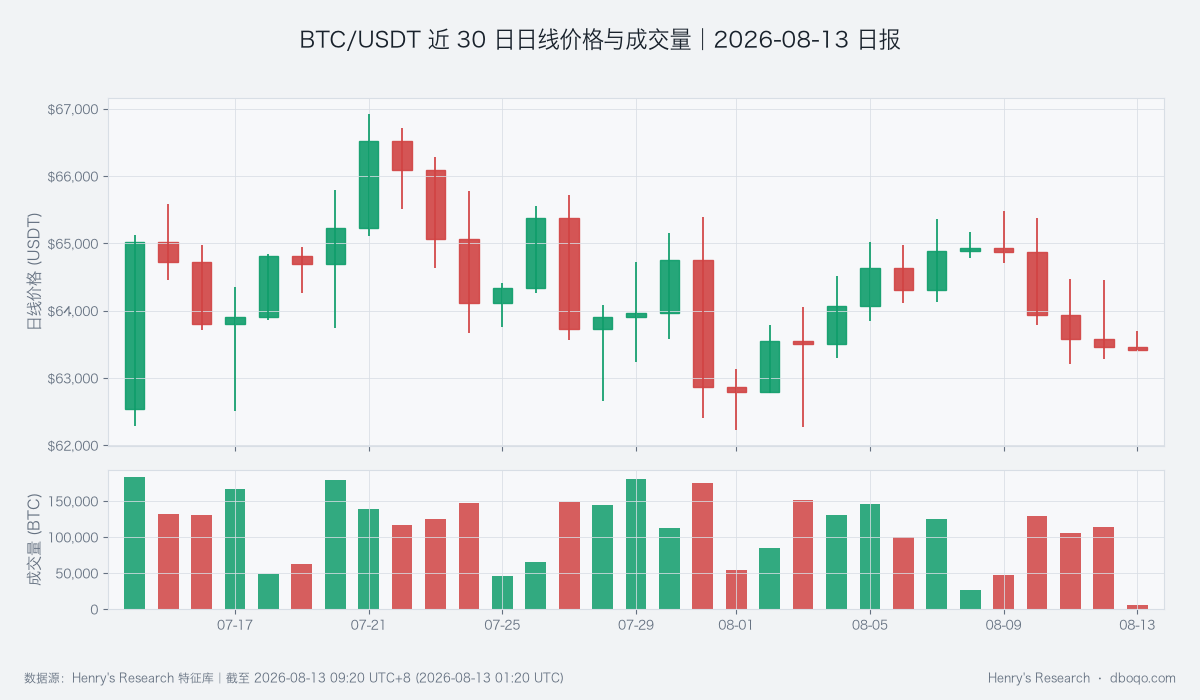
BTC/USDT daily price and volume over the past 30 days; price remains below the short- and medium-term moving averages, while volume has not confirmed a breakout.
Price Action and Trend: Resistance From Both Moving Averages Remains
The current price is below the 10-day moving average at 64,215.43 USDT and the 30-day moving average at 64,378.89 USDT, while the daily MACD histogram is -73.21 USDT. MACD tracks trend momentum, and the negative reading shows that the medium-term repair remains incomplete. Daily RSI is 45.45; RSI gauges the balance between recent upward and downward moves, and the current reading is neutral-to-weak rather than oversold. Price must first reclaim both moving averages and then show improving momentum. If it only touches that zone briefly before falling back, the bearish structure remains valid.
Price-Volume Structure and Price Range: Active Buying Is Unusually Weak
Active net-buying strength is -0.44, versus a historical average of -0.02, and is lower than about 86% of comparable periods, placing it at a depressed level. This measure compares aggressive buying with aggressive selling; a negative reading means sellers willing to transact immediately have the advantage. Its alignment with the price decline is an important confirmation of the bearish view. Price is near the lower part of its recent range, but the range width is only 0.56%, lower than about 88% of comparable periods, indicating compressed volatility. The next test is whether 63,283.00 USDT holds and whether active buying strengthens alongside any break above 64,450.00 USDT.
Derivatives Anomalies: High Financing Costs Meet Volatility Repricing
The current average funding rate is +0.008188%, with only about 6 of 180 comparable periods higher, showing that long-side financing costs have risen materially. The spread between implied and realized volatility is +8.04, compared with a historical average of -2.12, and only about 5 comparable periods were higher. This spread compares the options market's pricing of future volatility with volatility recently realized; a clearly positive value means options participants are paying more to prepare for a potential regime change. Derivatives participation increased 2.73%, also higher than about 85% of comparable periods. Together, the readings show rising contract participation and demand for volatility protection. If price weakens further, crowded trading may unwind more quickly.
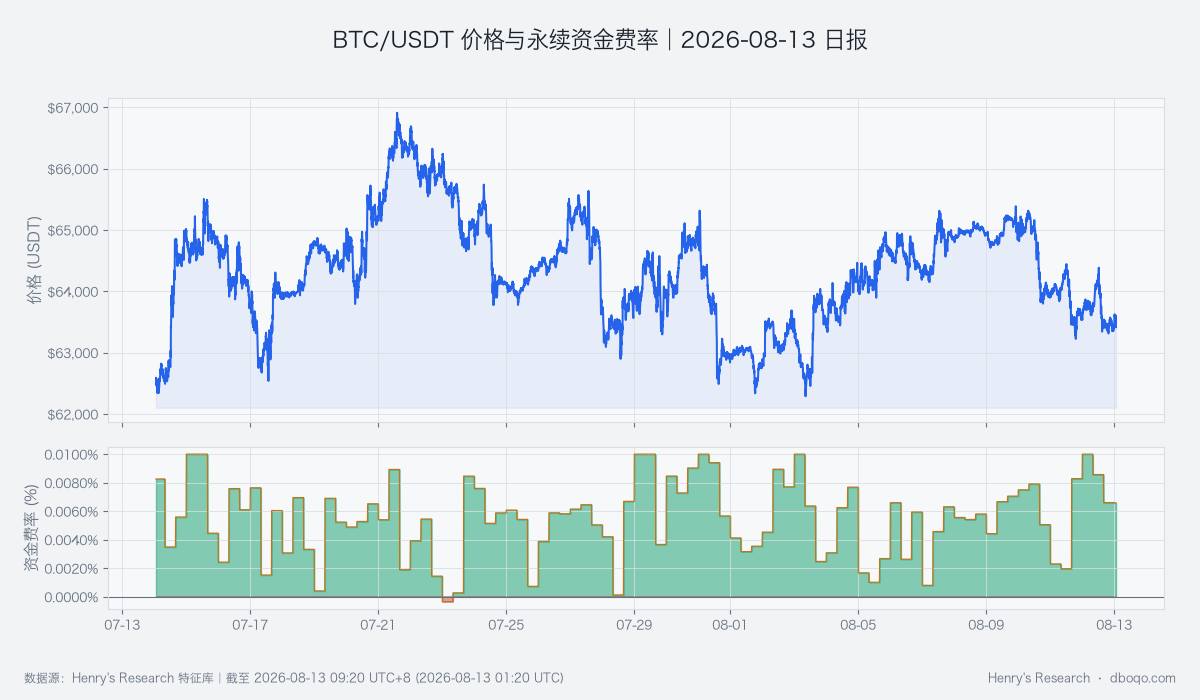
BTC/USDT price and perpetual funding rates over the past 30 days; funding has heated up without a price breakout, raising crowding risk.
Cross-Market and Capital Flows: External Conditions Cushion Risk but Lack Alignment
BTC cross-market capital temperature is neutral. ETF flows show a net inflow of 7,440 ten-thousand US dollars over the past 5 days, an improvement from the historical average net outflow of 0.81 hundred-million US dollars. The dollar is at a relatively low level and the volatility index is also subdued, conditions that usually support risk sentiment. However, 30-day stablecoin supply growth is -0.95%, weaker than the historical average of -0.13%, indicating that liquidity available to the crypto market is still not expanding. BTC's 30-day correlation with equities is -0.007, versus a historical average of +0.153, with only about 14 comparable periods as low or lower. Equity risk appetite therefore cannot directly confirm BTC's direction for now. The next test is whether ETF inflows persist and lead to better stablecoin supply growth and spot volume.
Combined Signal and Scenario Validation: Bearish Consensus Awaits a Price-Volume Reversal
The combined signal is bearish, consistent with the public market evidence of price below both moving averages, weak active net buying, and crowded derivatives conditions. The base case is weak trading within 63,283.00 to 64,450.00 USDT, with rebounds initially capped by the moving-average zone. A break below 63,283.00 USDT accompanied by stronger aggressive selling would further confirm downside risk. The alternative case requires price to reclaim 64,450.00 USDT on stronger volume while funding rates cool and active net buying turns positive. If all three occur together, the current bearish view is invalidated; a softer dollar or a single ETF inflow signal alone is not enough to change direction.
Risk Warning: A Low-Volatility Market Can Shift Abruptly
Realized volatility is currently subdued while the options market is pricing materially higher future volatility, so calm conditions may change suddenly. The transmission of macro risk sentiment, ETF flows, and stablecoin supply is not immediate and should not be interpreted as deterministic causation. Liquidation data is only a daily quantity proxy for the covered BTC perpetual markets. A brief move through a key level does not confirm a trend; closing price, volume, and aggressive buying and selling should be assessed together.
Disclaimer: This report was prepared by dboqo using market data available as of 2026-08-13 09:20 UTC+8. Cryptocurrency markets are highly volatile. This report provides objective analysis of market conditions only and does not constitute investment advice. Investors must assess risks independently and make prudent decisions.