I. Core Finding and Direction: A Price Surge Conflicts with Weakening Buying Momentum
Data scope: As of 2026-09-19 09:15 UTC+8, the current window covers the past 24 hours and is compared with 180 historical periods ending at the same time of day. Daily capital data retain their original measurement horizons and are not combined indiscriminately with short-term trading changes.
Core finding: BTC recorded an unusually sharp price advance, but the latest cumulative active buying and selling trend is weak, while cross-market capital conditions have not warmed in tandem. The central question has shifted from whether a rebound can occur to whether higher prices can attract sustained demand. Historical comparison: The current return is +5.99%, against a historical mean of +0.08%. Of 180 comparable periods, only about 2 had a higher return, placing the gain at an unusually high level. This indicates that the advance is well outside ordinary daily fluctuations; it does not imply that the probability of a further rise has increased. Continued new buying is the next test.
Measurement review: The price return is a statistical market anomaly. No candidates for unit, frequency, or scale inconsistencies were found, and daily observations were not repeatedly added across intraday intervals. Directional assessment: Conditionally bearish, referring primarily to pullback pressure after the surge. Assessment horizon: The next 24 hours. Conditions for validity: Active buying fails to recover, capital conditions remain cool, and price cannot establish itself above the current window's high. Invalidation conditions: Price breaks out and holds, active buying and volume strengthen together, and capital pressures stop worsening. That combination would require withdrawing the bearish assessment.
II. Key Market Data: Higher Volume Supports the Advance but Cannot Establish Its Durability
The latest price is 81,138.40 USDT, still near the current window's high, indicating that the gains have not been substantially surrendered. Volume over the past 24 hours was 226,168 BTC, against a historical mean of 150,513 BTC, higher than about 87% of comparable periods. This expansion is important evidence against an immediately weak outlook: the advance was not driven solely by extremely thin trading. However, volume measures exchanges between buyers and sellers and cannot, by itself, demonstrate that fresh demand will continue at higher prices.
The more useful test is how the market behaves on a pullback. A decline on contracting volume followed by prompt buying would indicate limited selling pressure and weaken the bearish case. Repeated heavy trading near the high without further progress would instead suggest that activity is not translating into stronger acceptance of higher prices. Elevated volume therefore provides a basis for testing continuation, rather than proof that the advance must persist.
III. Price Action and Trend: Short-Term Strength Is Evidence the Bearish Assessment Must Address
Price is above its short- and medium-term daily moving averages, and the short-horizon moving-average spread is positive, indicating a real improvement in the short-term trend. The combination of an unusually large gain and improving trend leaves no basis for claiming that a decline has already begun. The bearish assessment concerns future buying support; concern about follow-through must not be presented as an observed fall.
A sustained advance generally requires acceptance of prices after a breakout, rather than a rapid jump alone. The focus is whether consolidation near the high remains stable and whether pullbacks are followed by higher lows. If trend improvement broadens and buying strengthens, the bearish assessment should receive less weight even if capital conditions remain cautious. Conversely, if improvement is confined to the gain already recorded while new attempts to advance fail, the pullback scenario would become stronger.
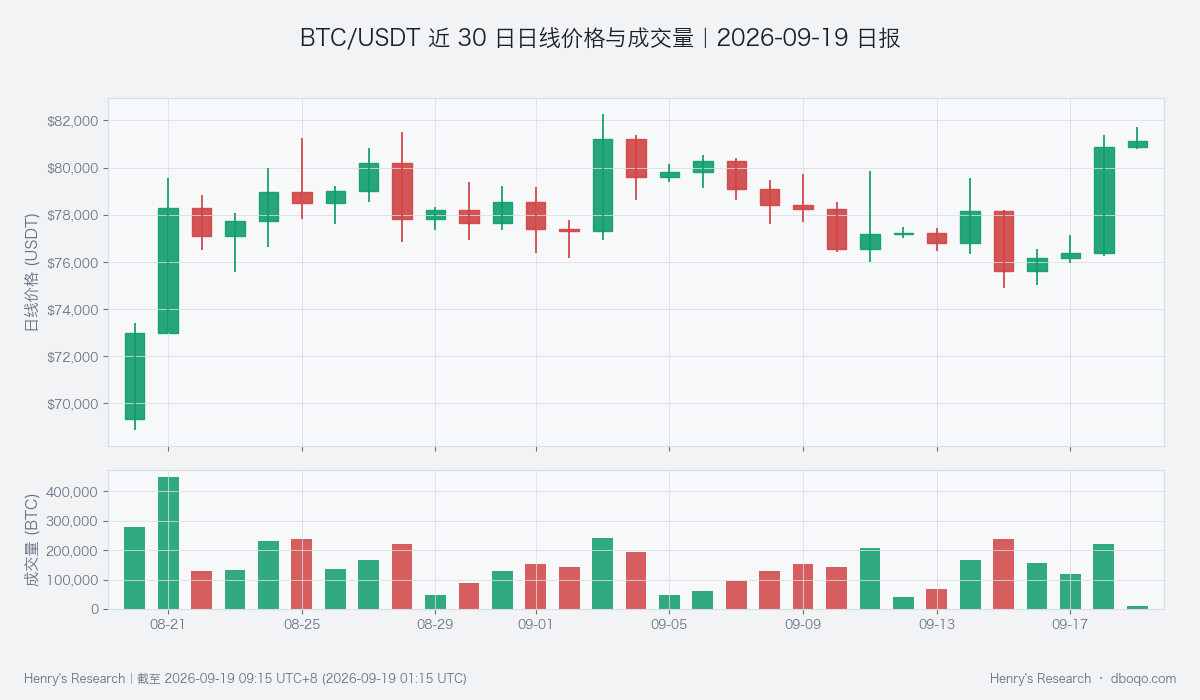
BTC/USDT daily price and volume over the past 30 days; the final day is incomplete and its volume should not be compared directly with full days.
IV. Price and Volume Structure and Price Range: Weaker Active Buying and Selling Leave Support at the High Untested
Active buying minus active selling helps identify which side is more willing to trade immediately. Its latest cumulative trend reading is -184 BTC, against a historical mean of -8 BTC. Of 180 comparable periods, only about 17 were as low or lower, making this an unusually weak reading. This is a key reason for caution after the surge: the latest trading initiative favors sellers. However, it is a short-horizon trend measure, not total net outflow over the past 24 hours, and it does not erase buying earlier in the advance.
The current window's high of 81,732.40 USDT provides a direct reference for testing continuation. A sustained move above it would challenge the view that buying support is insufficient; repeated tests without progress would raise concern about fading short-term momentum. The price range defines where to assess the evidence, not a promise that price must reach or reverse at a particular level. Short-term trading initiative should be read alongside price action, rather than using a single negative reading to characterize the entire move.
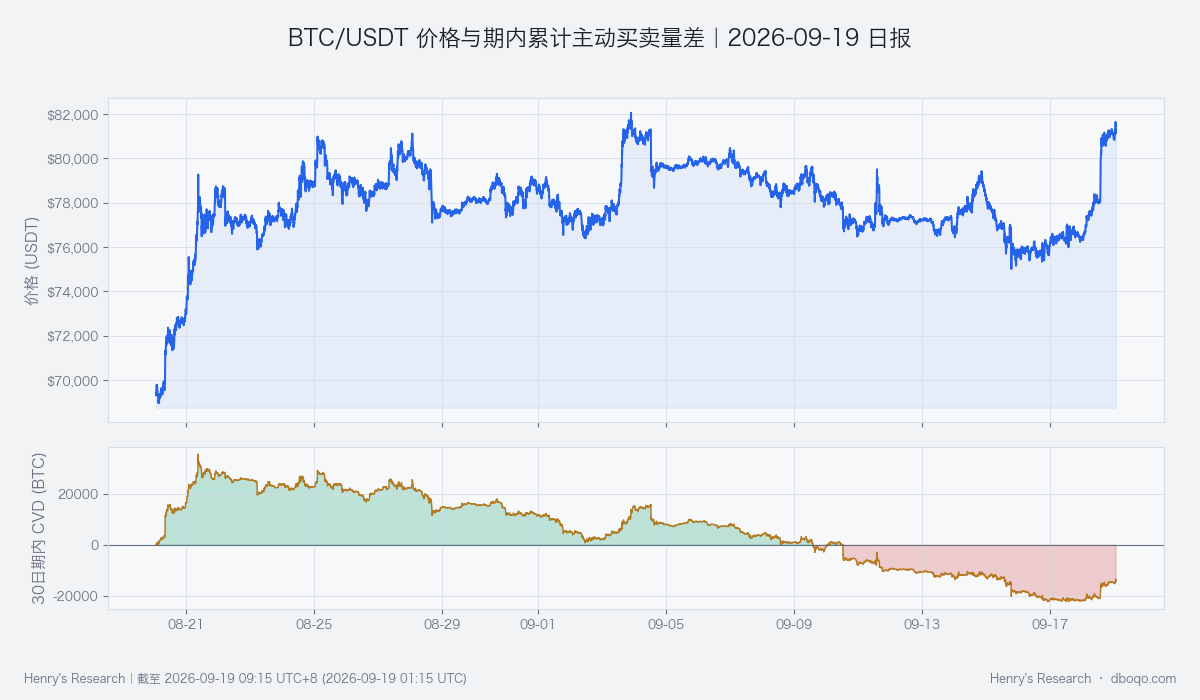
Price and cumulative active buying minus active selling over the past 30 days; the cumulative curve and the latest short-horizon trend use different observation windows.
V. Derivatives Developments: Elevated Carry Costs Raise the Bar for Sustained Gains
The funding rate reflects periodic payments between the two sides of perpetual contracts. The current window's average is +0.007446%, against a historical mean of +0.003145%, higher than about 88% of comparable periods. A positive rate means the bullish side bears the payment cost. Alongside the sharp price rise, this suggests that further gains need spot and active demand; otherwise, waiting itself adds pressure. However, this measure did not cross the statistical anomaly threshold for this report and cannot establish overheating or reversal on its own.
This comparison uses average funding rates over equivalent windows, not an individual settlement rate, and is not converted into an annualized return. Continued price strength with falling payment costs would ease the cost constraint and weaken the bearish evidence. Costs remaining elevated while active buying stays weak would make pullback risk more relevant.
VI. Cross-Market and Capital Conditions: Cool Capital Conditions Have Yet to Confirm the Surge
The BTC cross-market capital temperature is cool, indicating that the combination of external capital and macroeconomic conditions has not become broadly supportive. Net ETF outflows over the past 5 days, contracting short-term stablecoin supply, and elevated relative dollar pressure act as constraints. Continued expansion in longer-horizon stablecoin supply is a counterweight that should not be ignored. The expected US equity volatility environment represented by VIX does not show extreme stress, so cool conditions should not be equated with systemic panic.
These are background conditions. ETF outflows cannot be claimed to have caused a current decline, nor does expanding stablecoin supply directly imply BTC buying. The key question is whether capital conditions can improve alongside the price advance. Easing dollar pressure, narrowing ETF outflows, and recovering short-term stablecoin supply would create a more favorable backdrop for continuation. If conditions stay cool, buying support near the high would depend more heavily on demand within the market itself.
VII. Combined Signal and Scenario Tests: A Bearish Signal Agrees with Capital Conditions but Conflicts with the Uptrend
The combined signal is bearish, consistent with the latest weakening in active buying and selling and cool capital conditions, but at odds with the strong price return, higher volume, and improving moving averages. The conclusion is therefore a conditional assessment of pullback risk that must acknowledge bullish counterevidence. The base scenario is consolidation of the sharp gain followed by a pullback if buying support is insufficient. If sellers become less aggressive while capital conditions remain cool, a range-bound phase may emerge before sustained upside can be confirmed.
Invalidation requires an observable combination: price holds above the breakout area, active buying regains a sustained advantage, volume supports further progress, and capital constraints stop worsening. A single upward spike or brief rebound is insufficient. Conversely, a loss of the high area accompanied by stronger seller initiative would provide fresh bearish evidence. The assessment should change with that evidence rather than forcing every development to fit a fixed view.
VIII. Risks
Historical comparisons describe relative positions within past comparable windows and do not provide probabilities of future gains or losses. Short-horizon trading data and daily capital information update at different rates. Macroeconomic events, changes in liquidity, and unexpected news can quickly overturn current relationships. A bearish bias does not mean prices must fall, and an unusually large advance does not mean a reversal is imminent. The stated validity and invalidation conditions require continued review.
Disclaimer: This report was prepared by dboqo based on market data as of 2026-09-19 09:15 UTC+8. Cryptocurrency markets are highly volatile. This report provides an objective analysis of market conditions only and does not constitute investment advice. Investors should independently assess risks and make prudent decisions.